

What Is a COSMOS Certified Ingredient, and Where Does It Differ From an Organic Certificate?
Does a plant's organic certificate also state the status of the raw material derived from it within a cosmetic formulation? Of the two documents being compared, one looks at the rules of agricultural production and the other at the status the raw material is counted under in a formulation. The question of what a COSMOS certified ingredient is generally arises while these two pages are being read, because the two use similar wording yet answer different questions.
From Field to Formulation: What Is a COSMOS Certified Ingredient?

The COSMOS-standard is a private-sector standard written for natural and organic cosmetics; it covers finished products and raw materials together, and version 4.2 has applied since 1 September 2025. On the raw material side two separate statuses are defined. A raw material with organic content that has been certified is labelled COSMOS CERTIFIED. A raw material without organic content, of mineral origin or for which organic content cannot be calculated, may be labelled COSMOS APPROVED once approved by a certification body; its label may make no reference to the terms organic or certified. Both are part of the same standard, yet what they express within a cosmetic formulation diverges.
What the standard looks at is not only a list of processes; the prohibition of genetically modified organisms and irradiation, packaging criteria and an environmental management plan are also within the text.
The Organic Regulation Governs Processing, Not Only the Field
Organic certification rests on a public framework. In the European Union, Regulation 2018/848 defines organic production, conversion periods and traceability, but its subject is not confined to agriculture: additives and processing aids that may be used in processing are assessed individually and taken onto a permitted list. Essential oils are also among the products closely linked to agriculture, listed in Annex I of the regulation. Distillation, then, is not outside organic supervision.
The distinction becomes clear elsewhere: the regulation asks whether organic character has been preserved throughout processing, while COSMOS describes the status under which the same substance may appear in a cosmetic formulation.
| Question | Organic certificate | COSMOS-standard |
|---|---|---|
| What it looks at | Rules of organic production and processing | The status of the raw material in a formulation |
| Basis | Public regulations such as EU 2018/848 | COSMOS-standard v4.2, a private-sector text |
| Raw material status | Organic or not organic | COSMOS CERTIFIED or COSMOS APPROVED |
| Scope | Production, processing, permitted inputs | Process, origin, GMO and irradiation prohibition, packaging, on-site inspection (documentation only for some raw material approvals) |
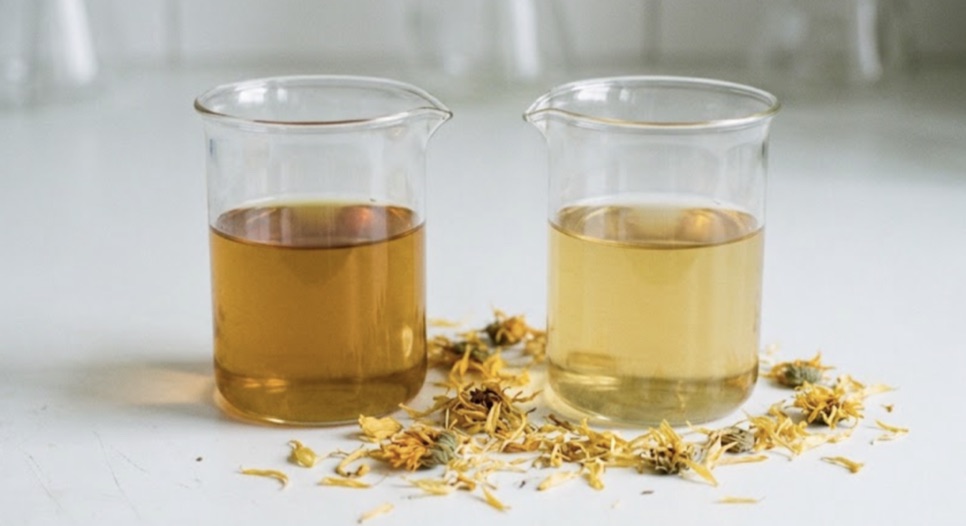
Two extracts prepared from a single harvest batch of Calendula officinalis flowers can fall into two separate statuses on the cosmetic side once the extraction solvent or the fractionation step changes.
When the two documents are read one after the other, the fields do not overlap. One states the producer, the parcel information and the body carrying out agricultural inspection; the other the process category, the organic content percentage and the cosmetic certification body. The only heading they share is the name of the plant. Compressing two sets of fields into the sentence "it has an organic certificate" makes it invisible which information is still missing before formulation begins. The number of documents in a folder does not mean the same thing as the number of questions answered.
Can an Ingredient Be Organic Without Being COSMOS Approved?
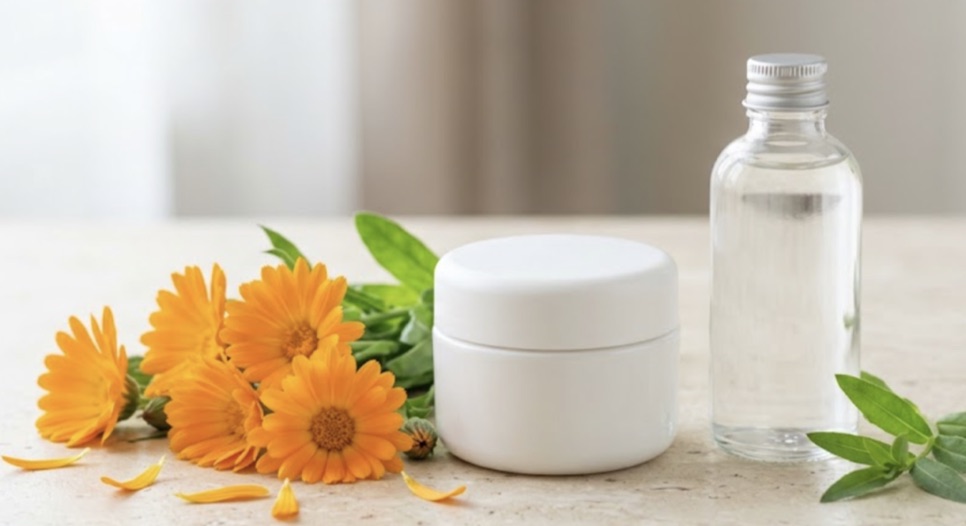
It can, and the reverse is possible too. An extract prepared from an organically certified plant by a method the standard does not accept remains with its agricultural certificate and finds no counterpart on the cosmetic side. An ingredient of mineral origin, or water, cannot be calculated as organic, yet may appear in a certified formulation with approved status.
On the finished product side the claim threshold varies by product type. In an organically certified cosmetic, at least twenty percent of the total product is required to be organic; for rinse-off products, aqueous products containing no emulsion and formulations with at least eighty percent mineral content the threshold falls to ten percent. Because water and minerals do not enter the organic calculation, the same raw material is reflected differently on the label in two different product types.
In Greenext's production the identity of a batch is established by harvest information and process information together; the status under which a raw material will be referred to before formulation is read from those two.
Frequently Asked Questions (FAQ)
How does the difference between a COSMOS certified and a COSMOS approved raw material appear on the label?
The label of a raw material whose organic content is certified carries the certification body and the organic content percentage by weight. A raw material with approved status is referred to without any reference to the terms organic or certified, because it has no content that can be calculated as organic.
Can an organically certified essential oil be used directly in a COSMOS certified finished product?
An organic certificate alone is not considered sufficient. Although essential oils fall within Annex I of the organic regulation, on the cosmetic side the processes the substance has passed through and the raw material status it falls under are assessed separately.
Why is the proportion required for an organic claim lower in a rinse-off product than in a leave-on one?
While the standard requires a twenty percent proportion in the total product, it grants a ten percent exception to rinse-off products, aqueous products containing no emulsion and predominantly mineral formulations. In these formulations the share of water and minerals is high, and neither is included in the organic calculation.
References
The COSMOS-standard, Version 4.2 (in force from 1 September 2025). COSMOS-standard AISBL, 2025. https://media.cosmos-standard.org/filer_public/2f/6b/2f6bd179-76e1-46bc-b76f-b503e3ccb135/cosmos-standard_v4-2.pdf
Regulation (EU) 2018/848 on organic production and the labelling of organic products; processing rules and the Annex I list of products closely linked to agriculture. European Parliament and Council, 2018. Overview page: European Commission, Directorate-General for Agriculture and Rural Development. https://agriculture.ec.europa.eu/farming/organic-farming/organic-production-and-products_en


