

Extract, Hydrosol and Essential Oil: Which Fraction Goes Where?
Why are the extract, hydrosol and essential oil that emerge after a harvest batch is processed not treated as more concentrated or more dilute versions of one another? The difference between extract, hydrosol and essential oil is often remembered as a price ranking. What separates the three is not their botanical identity; what decides the matter is which fraction is taken from the plant at which physical step. The same species name may appear on all three labels, yet the chemical subset entering the formulation is different each time.
Solvent, Steam, Condensing Water: Separation Happens at Three Different Steps
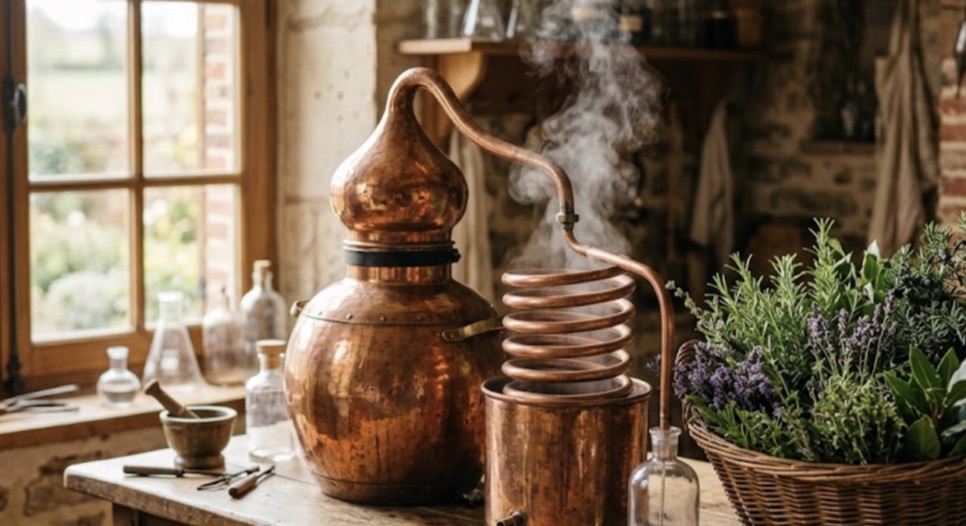
An extract is a matter of solvent. Water, a hydroalcoholic mixture or glycerine draws out whatever in the plant matrix matches its own polarity; phenolic compounds, flavonoid glycosides, tannins and polysaccharides therefore concentrate on the extract side. Most of the volatile constituents, meanwhile, leave the system during the concentration and drying steps.
On the essential oil side the definition is not tied to a single method. In international terminology (ISO 9235:2021), an essential oil covers not only steam distillation but also products obtained from the epicarp of citrus fruits by mechanical means including cold pressing, as well as products of dry distillation. On the distillation line the oil phase leaving the condenser collects above the water phase in most oils; those heavier than water, such as clove, cinnamon bark and wintergreen oils, gather below.
There are also constituents that form during distillation. Chamazulene is not present ready-made in the plant; it appears as an artefact converted by heat from the proazulene matricin during the distillation of Matricaria chamomilla. This conversion is not markedly present on the Chamaemelum nobile side, because that species has different sesquiterpene lactones.
The hydrosol is the condensing water phase of this distillation. It is not the process water left at the bottom of the still but the condensate that leaves the condenser together with the oil phase and remains once the two are separated. It carries predominantly relatively water-soluble molecules such as oxygenated monoterpenes; by mass, almost all of the liquid is water.
| Raw material | Route of production | Fraction it carries |
|---|---|---|
| Extract | Solvent extraction (water, hydroalcoholic, glycerine) | Polar and semi-polar constituents soluble in the solvent |
| Essential oil | Steam distillation, mechanical separation from citrus epicarp, dry distillation | Lipophilic volatile terpenic phase |
| Hydrosol | The water phase condensing during distillation | Water-soluble aromatic fraction, the rest water |
The Percentage on a Hydrosol Report Is a Percentage of What?
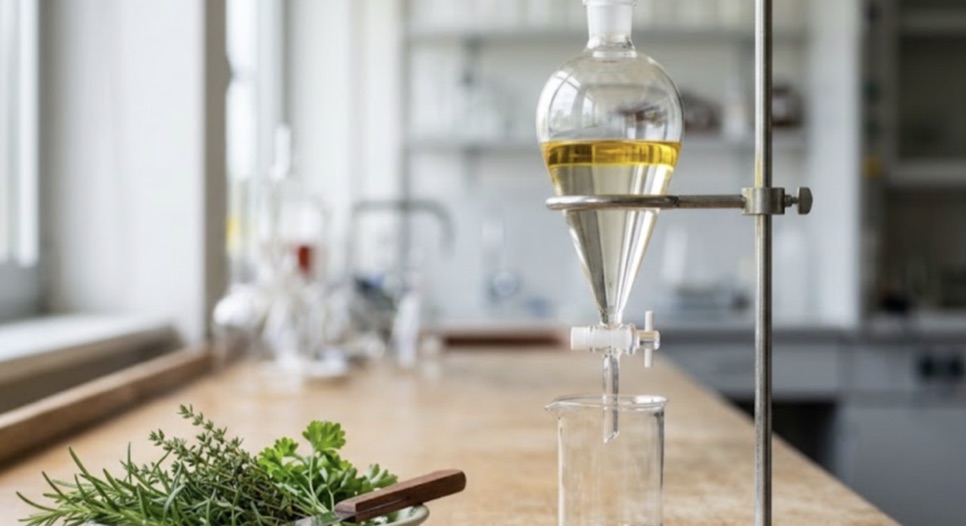
A line reading "98 percent oxygenated monoterpenes" on a hydrosol report is read as a proportion of the total mass of the liquid. The volatile fraction of a hydrosol is profiled either by extracting it with a solvent and running GC-MS, or by headspace-based techniques; in both cases the reported percentages show only the relative distribution within that fraction. In a study on eucalyptus hydrosols the greater part of the volatile profile consisted of oxygenated monoterpenes, while the concentration of the dominant constituent 1,8-cineole in the liquid was measured in the order of grams per litre.
When two different measurements are applied to the same sample, two different pictures emerge: relative distribution gives shares within the fraction as percentages, while concentration determination gives the amount per litre. If both produce a correct result, which number describes the raw material? The percentages tell you what the water has held, the concentration how much of it. This is also why hydrosol reports look simpler than essential oil reports; throughout distillation the water phase has retained only the molecules that match its own polarity.
When Three Inputs Meet in One Formulation, What Happens to the Phase Distribution?
For the formulator the question is not which is stronger but which gap will be filled on the water and oil sides of the formulation. An essential oil sits in the oil phase and, even at a low dose, markedly changes the odour and constituent load. An extract is usually carried on the water or glycerine side and brings the behaviour of its own solvent along with it. A hydrosol, because it mostly takes the place of the water phase, works out as a decision about the carrier rather than about an additive.
The species name appearing three times on a label therefore corresponds to three separate inputs working in three separate regions of the formulation. At Greenext, too, three lines run separately: from distillation the oil phase and the condensing water phase are taken from their own outlets, while the extract is produced on its own solvent line.
Frequently Asked Questions (FAQ)
Is lemon peel oil obtained by cold pressing also considered an essential oil?
It is. The international definition does not limit essential oils to distillation products; products obtained mechanically from the epicarp of citrus fruits and products of dry distillation fall into the same category.
Is a hydrosol an essential oil diluted with water?
No, because dilution is an operation carried out afterwards, whereas a hydrosol is the water phase that condenses during distillation itself, and its contents have separated of their own accord according to water solubility. Its constituent ranking therefore does not follow the ranking in the essential oil of the same plant.
Do an aqueous extract and a hydrosol serve the same phase role?
As a phase both sit on the water side, but the load they carry is not the same. In an aqueous extract, water plays the role of the solvent drawing phenolic constituents from the plant; in a hydrosol, water carries the aromatic fraction as the phase condensing during distillation.
References
German and Roman Chamomile: Species-Specific Phytochemical Profiles, Bioactive Potential, and Relevance for Functional Foods and Nutraceutical Development. Nutrients (MDPI), 2026; 18(13):2181. https://pmc.ncbi.nlm.nih.gov/articles/PMC13363751/
GC-MS and HS-SPME-GCxGC-TOFMS Determination of the Volatile Composition of Essential Oils and Hydrosols (By-Products) from Four Eucalyptus Species Cultivated in Tuscany. Molecules (MDPI), 2019; 24(2):226. https://pmc.ncbi.nlm.nih.gov/articles/PMC6358850/


