

What Does a 4:1 Extract Mean? The Arithmetic Behind the Extract Ratio
When four kilograms of dried plant material yield one kilogram of powdered extract, where do the remaining three kilograms go? The extract ratio is the shorthand for this mass story; yet for most buyers who see a 4:1 or 10:1 line on a quotation, the first thing that comes to mind is not yield but strength. The figure, however, does not measure how potent an extract is; it records how the mass was distributed during production.
The Extract Ratio Records Where the Mass Went
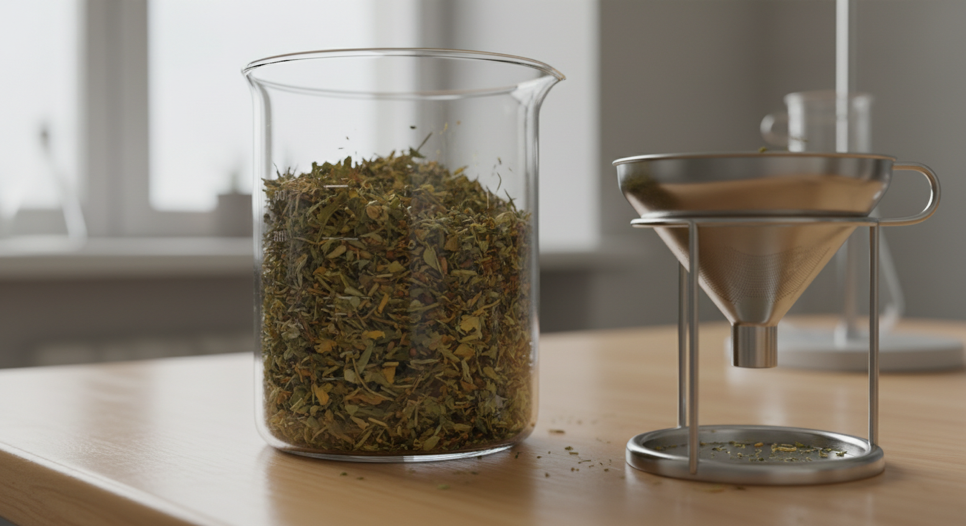
The term known in the literature as drug-to-extract ratio, or DER for short, states how many units of plant material produced one unit of extract; the material is usually the dried herbal substance, and a DER calculated on fresh material is declared separately. Most of the three lost kilograms do not evaporate: plant tissue that does not pass into the solvent is separated from the liquid phase as marc during filtration, while the solvent itself is removed in the concentration and drying steps.
The level at which the ratio lands is set not only by the plant's chemistry but also by the solvent system, the drug-to-solvent ratio, temperature, time, particle size and drying method. This is why yield cannot be read as an intrinsic property of the raw material.
The European Medicines Agency's declaration guideline draws a second distinction here: the native (genuine) DER, which refers only to the plant-derived portion without carriers, and the total DER, calculated with carriers included, are not the same quantity. Two formulators looking at the same 10:1 figure on a label may be talking about different amounts of plant material. These guidelines belong to herbal medicinal product regulation; on the cosmetic or food ingredient side they impose no mandatory form of declaration, but they circulate in the sector as a shared set of definitions.
Why 10:1 Is Not a Comparison Tool on Its Own
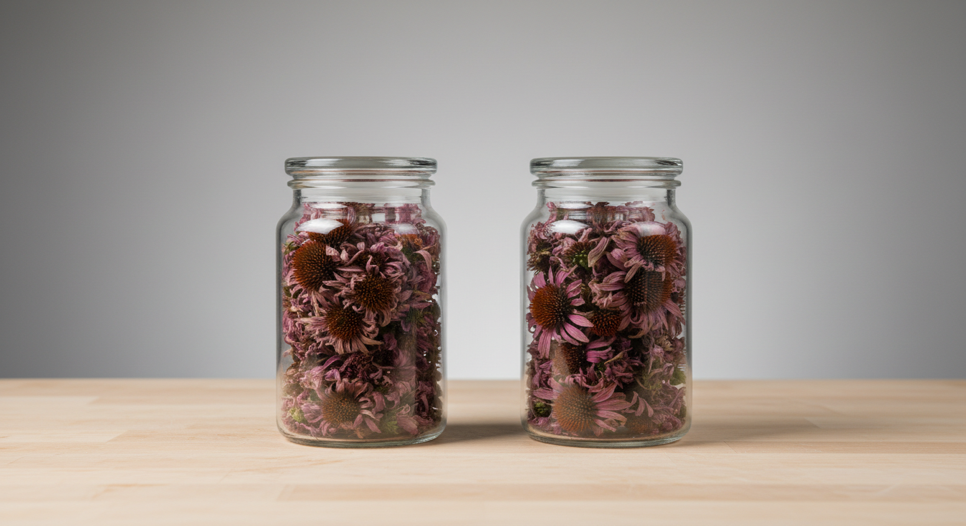
If two samples from two suppliers both say 10:1, can they be assumed to be the same raw material? When one is produced by aqueous extraction and the other with 70 percent ethanol, the resulting constituent profiles diverge markedly. A polar solvent brings the polysaccharide and phenolic acid side forward; a hydroalcoholic system brings forward the flavonoid and resin side. The ratio looks the same in both.
Then there is agricultural variability. The yield obtained from Echinacea purpurea in one harvest year may not hold the following year. This is why specifications often show ranges such as 4-6:1; the range is biological reality written down.
| What the label shows | What it tells you | What it does not tell you |
|---|---|---|
| DER 4:1 | Yield by mass, one unit of extract from four units of plant material | The percentage of any specific constituent |
| DER 4-6:1 | Harvest-related yield range | Constituent consistency between batches |
| 5 percent rosmarinic acid (illustrative example) | Measured constituent content | How much plant material was used |
The information in the right-hand column never replaces the information in the left-hand column; no single figure closes the gap between them.
A small calculation makes that gap visible. Four kilograms of a plant material carrying 2 percent of a target constituent contain 80 grams of that constituent; if all of it passes into the solvent, the resulting kilogram of extract carries 8 percent. If half of the constituent stays in the marc, the ratio still reads 4:1 but the content drops to 4 percent. Within a range where the target constituent share can double or halve while the figure stays fixed, what data is left to assume two samples are equivalent? The ratio comes out correct in both cases, because the ratio counts what remained, not what passed into the solvent.
When Standardisation Enters, the Conversation Changes
The classification based on the European Pharmacopoeia's general monograph on extracts (0765) defines three groups: standardised, quantified and other extracts. In a standardised extract a specific constituent is adjusted to a defined value; in a quantified extract the content is adjusted to a defined range by blending batches; other extracts are described essentially by their production process. This threefold distinction operates independently of the DER.
The ratio looks backwards and states how much plant material was consumed; standardisation looks forwards and declares what is measurably present in the extract and in what quantity. A 4:1 extract may have been adjusted to a defined constituent value, while a 20:1 extract may not be tied to any analytical target at all.
Ultimately, what defines an extract is not a single figure but the knowledge of which plant material, which solvent and which drying line produced that figure. In Greenext's extract production the ratio takes shape within the batch's own production flow, which is what stops it from being a statement added to the label after the fact.
Frequently Asked Questions (FAQ)
How does the difference between DER 4:1 and DER 10:1 translate into usage-rate calculations?
The conversion is made on the basis of equivalent plant material. For a native (carrier-free) DER, 1 g of a 4:1 extract corresponds to 4 g of plant material and 1 g of a 10:1 extract to 10 g. In carrier-containing products this conversion cannot be applied directly; even where it applies, it is an equivalence of mass, not of constituents.
How is the ratio read in an extract that contains maltodextrin?
Because the carrier increases the total mass, the native DER and the total DER diverge. If the declaration does not state which of the two is given, the figure on its own carries no interpretable information.
If a specification lists both a DER and a constituent percentage, which one is used for comparison?
The constituent percentage is measured analytically and allows comparison between batches; the DER is calculated from production masses and describes the process. On a specification the two sit on separate lines.
References
Guideline on quality of herbal medicinal products/traditional herbal medicinal products (EMA/HMPC/CHMP/CVMP/201116/2005 Rev. 3). European Medicines Agency, 2022. https://www.ema.europa.eu/en/quality-herbal-medicinal-products-traditional-herbal-medicinal-products-scientific-guideline
Guideline on declaration of herbal substances and herbal preparations in herbal medicinal products/traditional herbal medicinal products (EMEA/HMPC/CHMP/CVMP/287539/2005 Rev. 1). European Medicines Agency, 2010. https://www.ema.europa.eu/en/declaration-herbal-substances-herbal-preparations-herbal-medicinal-products-traditional-herbal-medicinal-products-scientific-guideline


