

Why Is Escin in Horse Chestnut Extract Not a Single Molecule?
When a supplier writes "20% escin", is there a single compound in that container, or a family of compounds? Escin, obtained from the seed of Aesculus hippocastanum, is in fact not a single molecule but a mixture of saponins made up of very closely related isomers. This distinction is the first thing to be known before a raw material containing escin is added to a cosmetic gel or massage formulation.
How Many Molecules Does Escin Actually Add Up To?
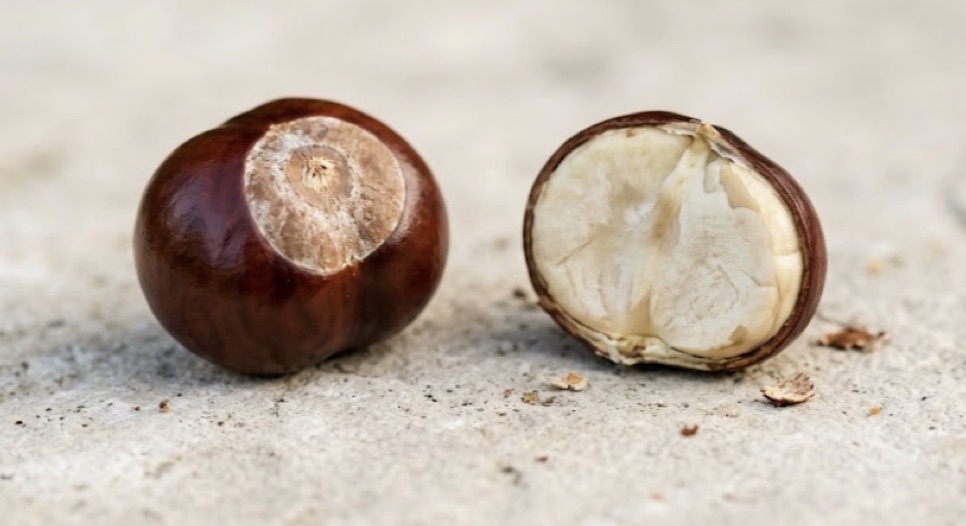
The word escin brings a single substance to mind, but laboratory analyses reveal a different picture. It is measured as the sum of several saponin isomers such as escin Ia, escin Ib, isoescin Ia and isoescin Ib, and these isomers can be told apart individually by HPLC. Published analyses show that four components make up roughly 60% of the mixture: escin Ia at 24%, escin Ib at 17%, escin IIa at 13% and escin IIb at 6%. The escin density inside the seed is not small either; the same study measured 52.05 and 34.9 grams per kilogram in the endosperm, that is a share of between three and six percent of the dry weight. For a formulator, this means that behind the label "20% escin" there is not a single chemical fingerprint but an isomer profile.
How Does the Seed Part Change Standardisation?
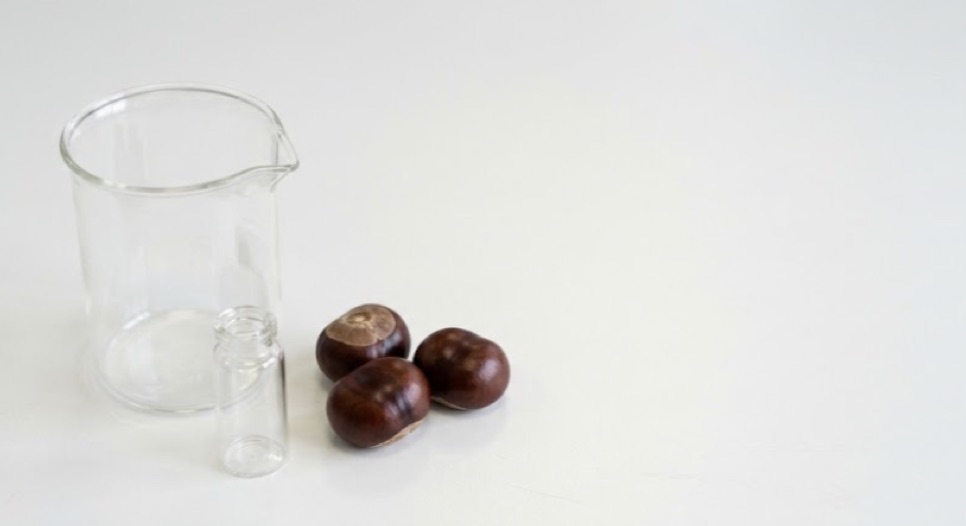
Not every region of the horse chestnut seed carries equal escin. The seed itself, that is the endosperm, is historically the part where the highest escin density is found, while the skin carries almost no escin at all, with only 0.32 and 0.19 grams per kilogram measured in the same analysis. During storage the amount of escin decreases over time in both parts. In one published analysis, after two years of storage the escin loss in the endosperm was measured at more than thirty percent, and in the skin at more than forty percent. For this reason, which seed part the raw material supplier starts from directly affects the final standardisation ratio. An escin extract for which it is not stated whether it was produced from the skin, the inside of the seed or a mixture of the two can be more open to batch-to-batch fluctuation and can show deviation between different harvest lots within the year.
Since escin is a saponin, what else changes in the formulation? By nature, saponins tend to form foam and lower surface tension. In a gel or cleanser formulation this can be both an advantage and a point of attention, because the saponin ratio determines the emulsion balance and the foam profile. When looking at the escin percentage, the formulator is actually buying surfactant behaviour as much as an active ingredient. Adding an extract with a high escin ratio to a low-viscosity gel base can bring with it a risk of unexpected foaming or phase separation, which is why a small-scale trial batch is always valuable.
Which Product Form Do the Standardisation Options Suit?
| Plant Part Used | Typical Standardisation | Suitable Product Form |
|---|---|---|
| Seed (endosperm), high standardisation | 16-20% escin (HPLC) | Revitalising serums, gel formulations |
| Seed (endosperm), standard level | 13-16% escin | Massage oils, body lotions |
| Highly concentrated standard extract | Above 20% escin | Eye-area care formulations, targeted gels |
The ratios in the table can vary from supplier to supplier, so which seed part and which extraction step the escin ratio comes from says more than the percentage alone. Two extracts carrying the same percentage may not be interchangeable in a formulation because of a different isomer distribution. This difference is most often visible not on the label but only in the chromatogram section of the analysis report.
Frequently Asked Questions
Does every extract with a high escin ratio have the same saponin profile?
No. The same percentage of escin can have a different isomer distribution, because the ratio of escin I and isoescin derivatives varies with the source.
Why is horse chestnut extract used carefully in foaming formulations?
Because escin is a mixture of saponins, it carries natural surface-active properties, which can affect emulsion and foam behaviour, and formulation testing is important for this reason.
Does escin standardisation change over time?
Yes, published data show that as storage time lengthens, the escin content can decrease in both the seed and the skin, so the batch date and the analysis report cannot be read separately from each other. A raw material batch kept for a long time may carry less active component than the percentage written on the label.
Keeping the saponin mixture in the horse chestnut seed consistent from batch to batch depends on fixing the extraction steps and the seed source. The technical information for Greenext's horse chestnut extract gives the escin content as three to six percent; alongside this the seed carries esculin (0.5-1%), flavonoids (1-3%) and tannins (2-4%). The standardisation ratio that goes on the label, however, comes not from that range but from the chromatogram of the batch in hand.
References
Savarino P, Colson E, André J, Gerbaux P. Horse Chestnut Saponins-Escins, Isoescins, Transescins, and Desacylescins. Molecules, 2023. https://pmc.ncbi.nlm.nih.gov/articles/PMC10004172/
Ghane SG, Attar UA, Yadav PB, Lekhak MM. Determination of Four Major Saponins in Skin and Endosperm of Seeds of Horse Chestnut (Aesculus hippocastanum L.) Using High Performance Liquid Chromatography with Positive Confirmation by Thin Layer Chromatography. Advanced Pharmaceutical Bulletin, 2015. https://pmc.ncbi.nlm.nih.gov/articles/PMC4729348/


