

Horsetail Hydrosol: The Toning Secret Silica Carries Into Water
The plant sought for centuries to keep the skin firm and taut, why is it always mentioned with the same unusual mineral, silica? How can we obtain this effect, referred to in traditional care as "toning", in a softened form that has come down into water? The answer lies hidden in horsetail hydrosol, distilled from the Equisetum arvense plant.
From Plant to Water: What Is Horsetail Hydrosol?
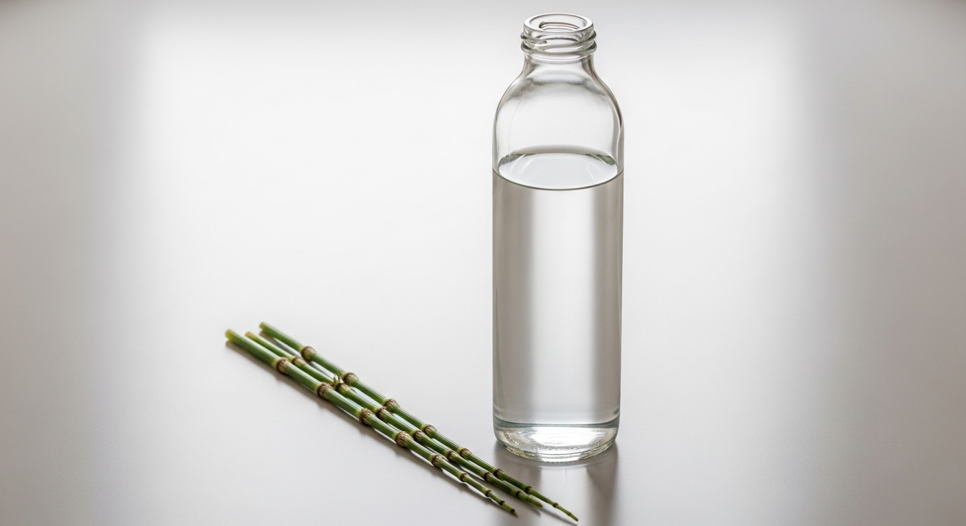
Horsetail hydrosol is the aromatic water phase that forms during the steam distillation of the above-ground parts of the Equisetum arvense plant. But how exactly does this water come about? As the plant is processed with steam, the rising steam carries both volatile and water-soluble compounds along with it. During condensation the oily part separates, and a water with its own distinctive scent, laden with components, remains. This water is the hydrosol.
The prominent components of this phase are silica (silicic acid) and phenolic compounds. There is an important distinction here: the hydrosol carries not the concentrated form of these substances, but their soft, water-soluble aromatic fraction. In other words, what you hold is not the harshness of the extract, but the gentle side of the water. This is also what makes a hydrosol appealing: a water close to the skin, light and easy to use. So what exactly is this gentle water useful for in cosmetics?
Toning and Firming Care: Horsetail Hydrosol in Cosmetics
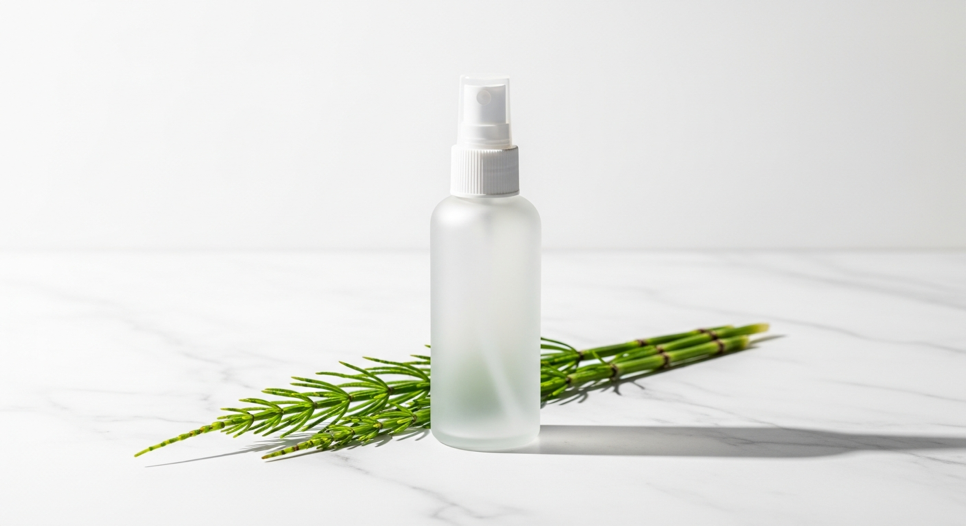
Horsetail is traditionally referred to as a plant that tones and firms the skin. Behind this perception lie the plant's silica-rich structure and its traditional use associated with collagen formation. The hydrosol, in turn, offers this heritage in a form that has come down into water and can be applied directly. Its low-intensity structure positions it as an intermediate step after cleansing or as the water base of a formulation.
| Application area | Form of use | Key feature |
|---|---|---|
| Facial toner | With cotton after cleansing or as a spray | Traditionally a toning feel |
| Mask and serum base | In place of water in clay or gel formulas | Water phase with silica and phenolic content |
| Refreshing mist | Misting onto the skin during the day | Light, water-soluble aromatic content |
Here is the crucial part. Silica and phenolic compounds are far more concentrated in the plant's extract and oil fraction. So what makes the hydrosol valuable? The answer is balance: the hydrosol offers a soft, water-based version of these substances that can be applied directly to the skin. The antioxidant properties of phenolic compounds have been examined in research, and while these are concentrated in the extract, the hydrosol serves as a gentle carrier that can easily enter a daily care routine. This is why it is more accurate to think of the hydrosol as a soft step that supports the routine, rather than a high-dose active. So the question may actually not be "which is stronger?" but "which is more practical for daily use?". Is a gentle water you can touch to your skin every day more useful than an intense but harsh extract?
From Plant to Product: Production and Standardisation
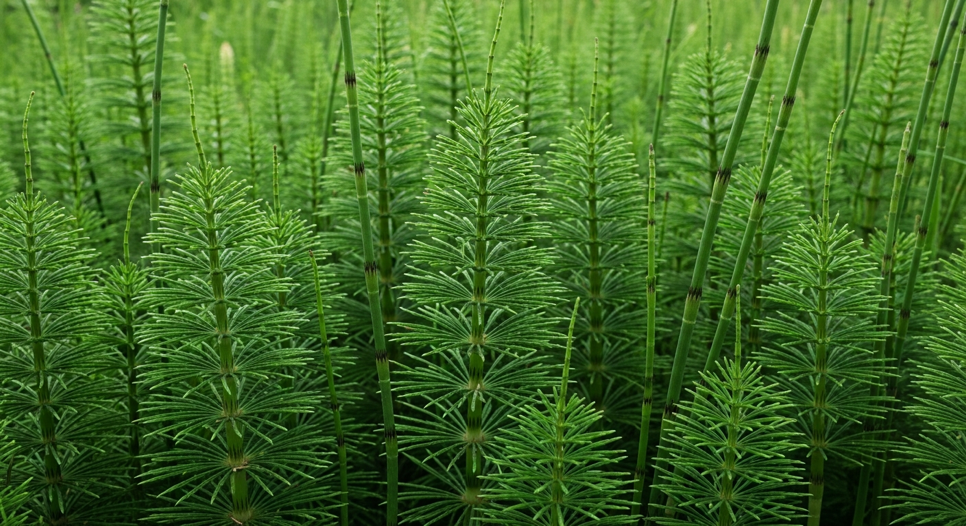
The composition of a hydrosol is not fixed. The region where the plant grows, the harvest time and the distillation conditions directly affect the component profile in the water. Even the same Equisetum arvense can give a different scent and content in different soils. Getting the same result twice from the same bottle is much harder than it first appears. So how is it possible for a brand to give the same result in every bottle?
The answer is in standardisation. When the distillation conditions, temperature, duration and plant-to-water ratio are kept constant, every batch is ensured to carry the same scent and component profile. This turns the hydrosol from an unpredictable plant water into a reliable cosmetic raw material. For the formulator, this means being able to work with the same base every time. This is also what Greenext aims for in its horsetail hydrosol: a consistent, traceable and formulation-ready water phase in every batch.
Frequently Asked Questions (FAQ)
Are horsetail hydrosol and its extract or oil the same thing?
No. The extract and oil contain the concentrated form of silica and phenolic compounds. The hydrosol, on the other hand, is the soft, water-soluble aromatic fraction that passes into the water during distillation. They come from the same plant, but the hydrosol is far gentler and water-based.
Does horsetail hydrosol cure a skin problem?
No. Horsetail hydrosol is a cosmetic component, not a medical product. It is traditionally associated with toning and firming care and should be thought of as a supporting care step. It is not used with a medical expectation.
Can I use horsetail hydrosol every day?
The hydrosol, with its gentle water-soluble content, is designed to suit a daily care routine. It can be used as a toner, a spray or a formula base. When trying a new product for the first time, testing it on a small area is always a good habit.
References
- Phytochemistry and Pharmacology of the Genus Equisetum (Equisetaceae): A Narrative Review of the Species with Therapeutic Potential for Kidney Diseases. Evidence-Based Complementary and Alternative Medicine, 2021. https://pmc.ncbi.nlm.nih.gov/articles/PMC7954623/
- Phenolic Compounds in Field Horsetail (Equisetum arvense L.) as Natural Antioxidants. Molecules, 2008. https://pmc.ncbi.nlm.nih.gov/articles/PMC6245282/
- Phytochemical Investigation of Equisetum arvense and Evaluation of Their Anti-Inflammatory Potential in TNFα/INFγ-Stimulated Keratinocytes. Pharmaceuticals (Basel), 2023. https://pmc.ncbi.nlm.nih.gov/articles/PMC10609812/


