

What Is the Difference Between Hydrosol and Essential Oil? (A Producer's Perspective)
When a formulator developing a water-based facial toner writes to their supplier "I want lavender", two completely different products may arrive. Either a dark, concentrated essential oil in a small bottle, or drums of clear, lightly scented water. Both come from the same plant, often from the same distillation batch. But one barely dissolves in water; the other is already water.
You do not realise you ordered the wrong phase until you see cloudiness or phase separation on the mixing table. And that means weeks of delay.
Two Products From the Same Still
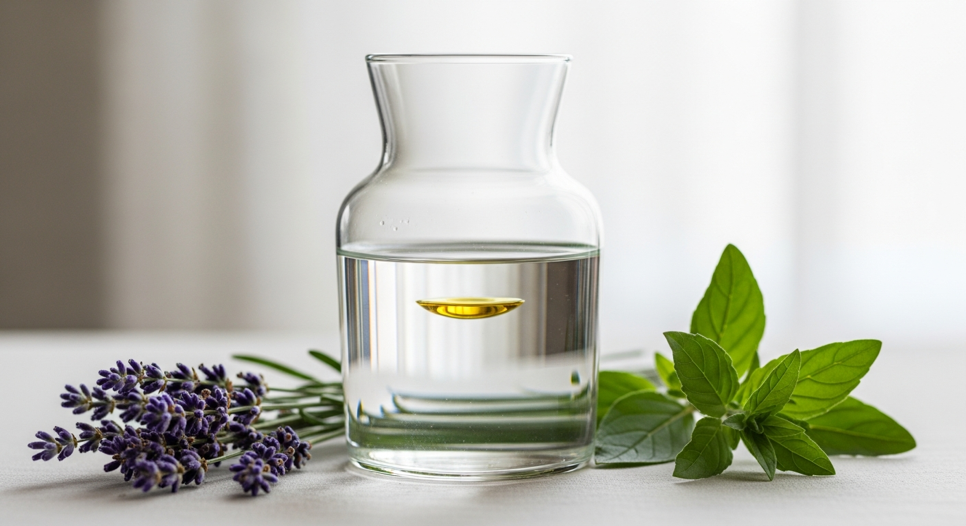
The source of both is a single process: steam distillation. As the steam passes through the plant material it takes the volatile aromatic molecules with it, condenses as it cools, and the liquid in the vessel separates into two phases. On top, the oil phase that does not mix with water collects, that is, the essential oil. Below remains the water phase: the hydrosol. This liquid is not simply "used water"; alongside water-soluble polar and oxygenated compounds, it carries trace amounts of volatile components.
There is a frequently confused point here. The molecule that gives a product its scent does not have to be the most dominant component by mass in that product. The molecules that carry the hydrosol's characteristic aroma make up a very small portion of the liquid by weight.
Oil Phase or Water Phase: Which Goes Where
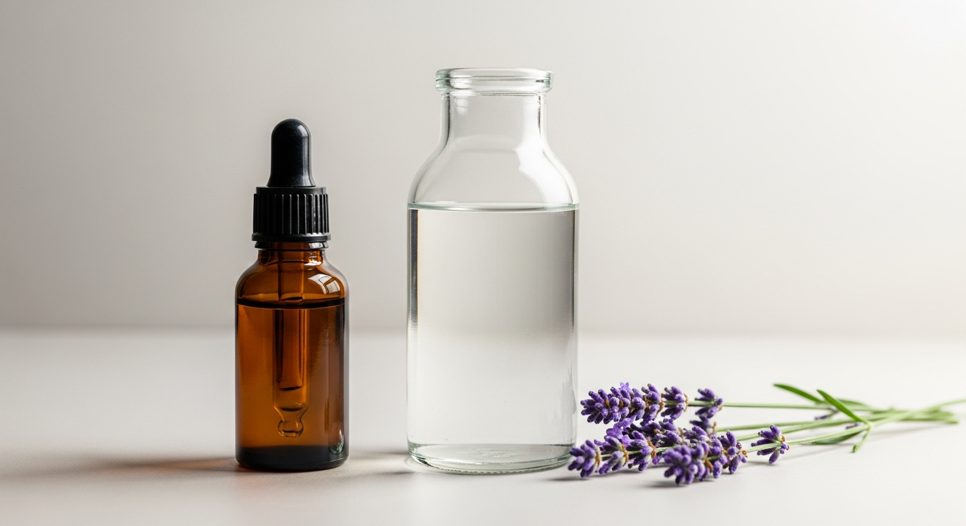
What determines the choice is solubility. The essential oil is lipophilic; it belongs to oil-based, water-free systems and is usually dosed at very low percentages or at ppm levels. The hydrosol, on the other hand, mixes with water in any proportion. This is why it can be used at much higher proportions in water-based formulations, like a ready-made water phase. The difference in concentration comes from here too. The essential oil is a product made almost entirely of volatile substance; the hydrosol is about 99 percent water, and the amount of dissolved volatile substance in it mostly stays below 1 gram per litre.
| Property | Essential Oil | Hydrosol |
|---|---|---|
| Phase and solubility | Lipophilic oil phase, insoluble in water | Water phase, mixes with water in any proportion |
| Volatile concentration | Almost entirely volatile components | ~99% water, volatiles usually <1 g/L |
| Typical use | Oil-based systems, low dose | Water-based systems, carrier water phase |
| Shelf life | Long, low microbial risk | Shorter, microbially sensitive |
| Sector | Perfume, flavour, cosmetic concentrate | Toner, spray, food flavour, agriculture |
Because the hydrosol is more microbially sensitive, aseptic filling and cool, closed storage are not a preference but a traceability requirement. The essential oil is far more tolerant on the shelf-life side.
The single discipline that determines the consistency of both products is distillation itself. The distillation time, plant-to-water ratio and cut points shape the profile of both the oil and the water at the same time. Thinking of the essential oil and the hydrosol as a single pair, a single process control, leaves the formulator with two raw materials that give the same result batch after batch.
Frequently Asked Questions (FAQ)
Can I use hydrosol instead of essential oil in a water-based formulation?
For water-based systems, the hydrosol mixes directly into the water phase and requires no additional solubiliser; the essential oil, on the other hand, does not disperse in the same system without an emulsifier or solubiliser. The right phase must be chosen according to the product's water-oil balance.
Do the percentages in a hydrosol's composition report refer to the whole liquid?
No. These percentages are the distribution within the volatile fraction measured by headspace GC-MS. Since the hydrosol is about 99 percent water by weight, the ratios in the report should be read according to the aromatic fraction, not the total mass of the liquid.
Why do hydrosol and essential oil have different shelf lives?
The high water content makes the hydrosol more open to microbial growth, which is why aseptic filling and cool storage are required. The essential oil's water content is negligible, and when stored correctly it remains stable for much longer.
References
- Unlocking the Potential of Hydrosols: Transforming Essential Oil Byproducts into Valuable Resources. Molecules, 2024. https://pmc.ncbi.nlm.nih.gov/articles/PMC11477756/
- GC-MS and HS-SPME-GC×GC-TOFMS Determination of the Volatile Composition of Essential Oils and Hydrosols (By-Products) from Four Eucalyptus Species Cultivated in Tuscany. Molecules, 2019. https://pmc.ncbi.nlm.nih.gov/articles/PMC6358850/


