

Why Is Immortelle Oil So Expensive?
Would it surprise you to hear that tonnes of flowers are needed to obtain one litre of immortelle oil? Immortelle oil, known botanically as Helichrysum italicum, is counted among the most expensive essential oils on the perfumery and cosmetic raw material market. There is no single reason behind this price. There are several production facts that feed one another.
Why Is the Yield So Low?
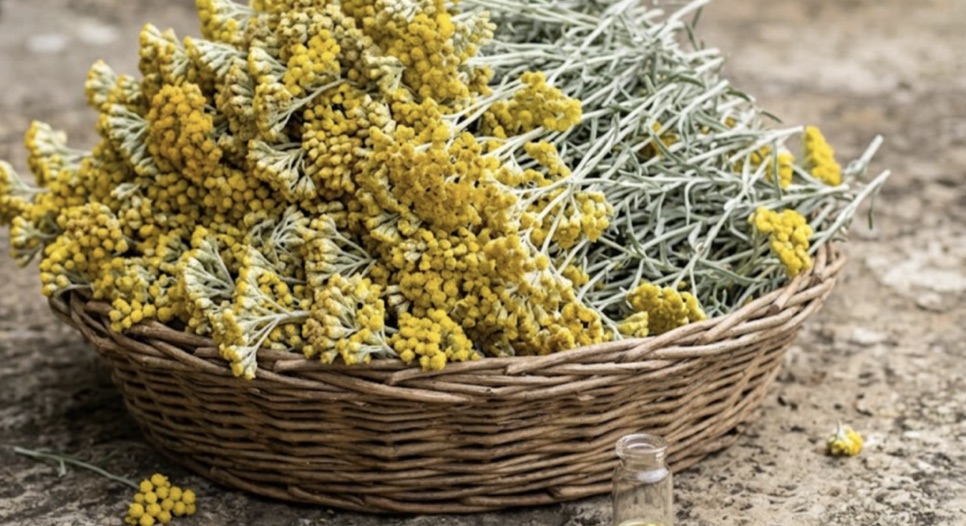
The yellow flowers of this plant from the Asteraceae family are processed by steam distillation, but the proportion of essential oil in the flower is quite limited. In one study the hydrodistillation yield was measured at roughly 0.44 percent by weight, which means the amount of oil obtained from hundreds of kilograms of fresh flowers barely reaches a few hundred grams. For comparison, in much more common essential oils such as lavender the yield is generally many times higher than this, so the amount of immortelle oil obtained from the same quantity of raw material is far smaller. The harvest is also squeezed into a narrow flowering window starting in June, which naturally limits the annual production volume. When this window is missed, that year's harvest has to wait until the next season. The flowers are picked by hand, not by machine, because the scattered growth habit of the plant and its delicate flower heads make bulk harvesting difficult. Hand picking both raises labour cost and keeps the amount that can be gathered in a day limited. When labour-intensive picking, a short harvest period and low distillation yield come together, the cost per kilogram rises quickly and this cost is reflected at every stage of the supply chain.
There Is No Single "Immortelle Oil"

Looking for a single standard immortelle oil profile on the market would be misleading. In an analysis of natural populations on the East Adriatic coast, the neryl acetate ratio was measured to stay between 2 and 11 percent, whereas in Corsican-origin samples mentioned in the literature the same component is reported to exceed 50 percent. Even plants from geographically close regions can carry different chemical profiles, which shows that genetic factors are more decisive than climate. Oils from Corsica, the Balkans and Anatolia are therefore, even when sold under the same name, different raw materials in the formulator's hands. So what does this variability mean for the buyer? A sample taken from one supplier may not carry exactly the same chemical signature in the next batch, so looking at the batch-based analysis report before formulation is not merely a formality.
The Chemical Signature Is More Than Smell

The characteristic smell of immortelle oil is generally carried by neryl acetate and related ester compounds, but it is not this ester group alone that determines the identity of the oil. In the same analysis the components that came to the fore in the Adriatic samples were identified as gamma-curcumene, ledol and eudesmol derivatives, that is, there are also profiles in which the ester group stays in the background. The component that dominates by mass is not always the component that gives the smell, which explains why leaving raw material assessment to a smell test alone falls short. If a formulator decides only by smelling, two batches that look the same may be found not to have the same component distribution. Chemical analysis here becomes a complementary step that reveals the difference the nose cannot catch. The table below summarises how origin and chemotype tendency carry into the formulation.
| Origin / Chemotype Tendency | Prominent Component | Result in the Formulation |
|---|---|---|
| Corsican-origin samples | Neryl acetate, above 50 percent | Dominant floral and fruity smell profile |
| East Adriatic populations | Neryl acetate, between 2 and 11 percent | Low ester share, a different smell balance |
| Prominent in Adriatic samples | Gamma-curcumene, ledol, eudesmol derivatives | Source of the woody and earthy nuance |
Even when this oil is added to a formulation, it is calculated at a very low dose, often at the milligram level. This once again brings forward both the cost and the importance of consistency between batches.
Frequently Asked Questions
Does immortelle oil give the same smell in every batch?
No. Because of differences in chemotype and origin, the smell intensity and nuance can change between batches, which is why the supplier's batch analysis report is the first document looked at before formulation.
Why is immortelle oil used at a very low ratio in emulsions?
The dense chemical profile and the cost of the oil generally lead formulators to work at a level of a few parts per thousand.
Can an immortelle oil sold far below the market average be genuine?
Given the distillation yield and the cost of hand harvesting, such prices raise the question of whether the raw material may have been diluted or blended.
In immortelle the harvest is squeezed into a few weeks of the year, but the long part of the work begins after those weeks. Because even two batches from the same field can carry a different component distribution, in Greenext's supply line every batch is entered into the record together with its own analysis.
References
Perković, I. et al. Chemophenetic Analysis of Ten Wild-Growing East Adriatic Helichrysum italicum Populations. PMC, 2024. https://pmc.ncbi.nlm.nih.gov/articles/PMC13539466/
Chemical constituents of Helichrysum italicum (Roth) G. Don essential oil and their antimicrobial activity. PMC, 2017. https://pmc.ncbi.nlm.nih.gov/articles/PMC5506734/


