

Lemon Balm Hydrosol: A Calming Water With a Lemon Scent
Lemon balm leaves a light, fresh, lemony scent when you rub its leaves. Why, then, is it sought after not only as a tea but also as a water-based cosmetic ingredient?
And what is the lightest way to carry this familiar aroma into a cream or a toner? Let us explore the details of lemon balm hydrosol.
What Is Lemon Balm Hydrosol?
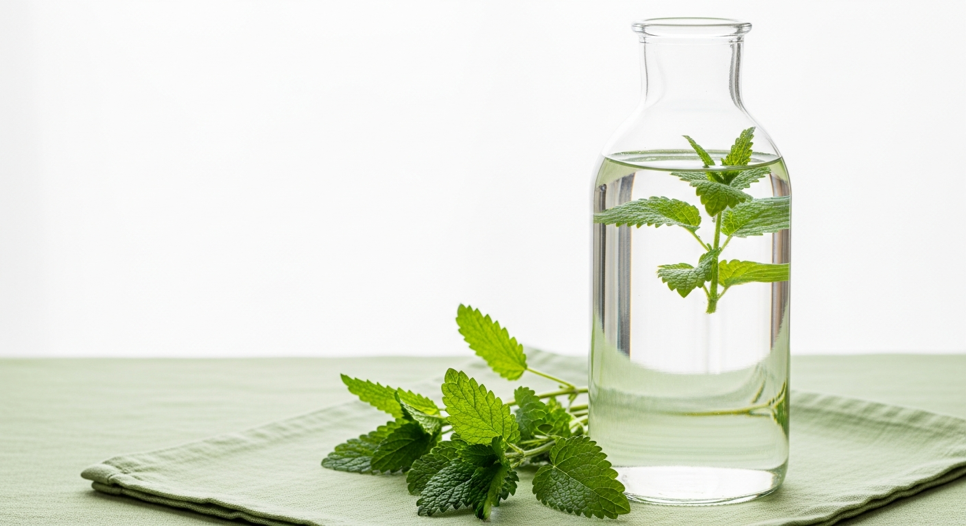
Lemon balm hydrosol (hydrolate) is the aromatic water phase that forms during the steam distillation of the leaves of the Melissa officinalis plant. The steam carries along the volatile and water-soluble components of the leaf; once it condenses, the oily portion separates and a fresh-scented water remains. That water is the hydrosol.
Two groups of compounds define lemon balm's character. Behind the lemony scent are volatile terpenes such as citral and citronellal; at the base of the antioxidant profile are phenolic acids. Foremost among them, rosmarinic acid is so defining in lemon balm that it is often used as an indicator of the plant's quality, that is, as a biomarker.
The hydrosol does not carry the concentrated form of this profile, but rather its water-soluble, fresh aromatic fraction. Indeed, one study examined the aqueous extract of lemon balm for its antioxidant properties and evaluated it in the context of physiological skin parameters; this makes it an interesting water-based ingredient for cosmetics.
Freshness and Skin: Lemon Balm Hydrosol in Cosmetics
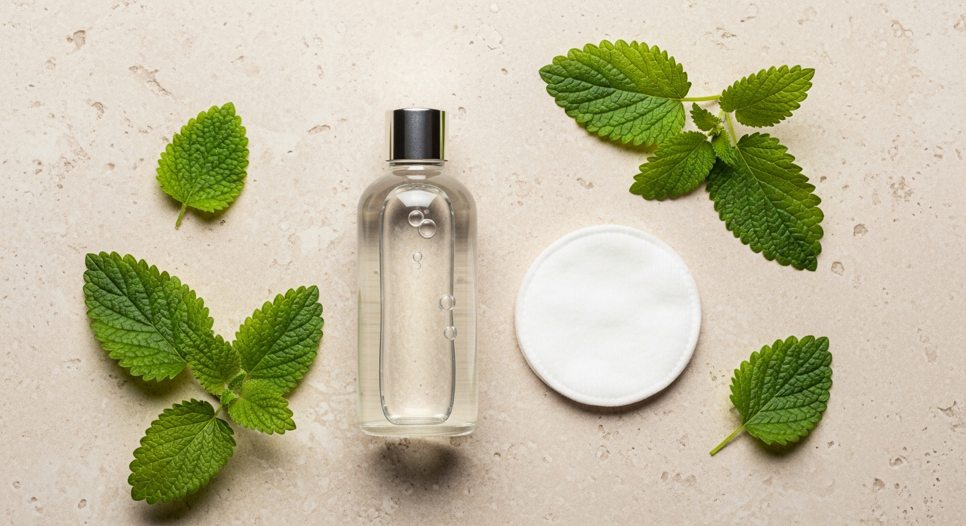
The place of lemon balm hydrosol in cosmetics is shaped by its fresh lemon note and its calming perception. Its water-based structure makes it suitable for adding directly to products built on a water phase, such as facial toners, facial mists, masks and scalp sprays. The invigorating character of the aromatic water stands out especially in formulations that promise freshness.
| Application area | Form of use | Key feature |
|---|---|---|
| Skin care | Facial toner, facial mist | Water-based, fresh aromatic water |
| Mask and serum | Water phase ingredient | Profile containing rosmarinic acid |
| Hair and body | Scalp spray, body mist | Lemony, invigorating scent |
There is an interesting detail here: the volatile components that give lemon balm its lemon scent are fragile, and their proportion can change according to distillation, harvest and storage. In other words, the scent of a fresh batch may not be the same as that of a batch kept for months.
Frequently Asked Questions (FAQ)
Are lemon balm hydrosol and lemon balm oil the same thing?
No. Both come out of the same distillation but they are different phases. The essential oil is the concentrated, oil-based part; the hydrosol is the far more diluted water phase carrying the water-soluble aromatic compounds. This is why the hydrosol is lighter and can be added directly to water-based products.
What does lemon balm hydrosol smell like?
The scent is largely determined by components such as citral and citronellal, which gives it a light, lemony, fresh and slightly sweet character. The intensity of the scent can vary from batch to batch according to distillation and harvest conditions.
Why is lemon balm hydrosol preferred in cosmetics?
Both its fresh lemon note and the antioxidant profile associated with phenolics such as rosmarinic acid make it interesting for water-based cosmetic formulations. Even so, it is evaluated as a cosmetic ingredient.
References
- Melissa officinalis L. Aqueous Extract Exerts Antioxidant and Antiangiogenic Effects and Improves Physiological Skin Parameters. Molecules, 2021. https://pmc.ncbi.nlm.nih.gov/articles/PMC8073307/
- Melissa officinalis L: A Review Study With an Antioxidant Prospective. Journal of Evidence-based Complementary & Alternative Medicine, 2016. https://pmc.ncbi.nlm.nih.gov/articles/PMC5871149/


