

Lemon Verbena Oil: That Familiar Scent Without the Lemon
When you pick a leaf of this plant and smell it, the scent of fresh lemon fills your nose, and yet this plant has no botanical kinship with lemon at all. So how does a leaf with no connection to the lemon tree smell so clearly of lemon?
The answer is simple. It is hidden in the volatile compounds in the leaf's structure, and especially in "citral", the lead actor of lemon verbena oil.
Which Lemon Herb? What Is Lemon Verbena Oil?

A confusion needs to be cleared up at the outset, because more than one plant is referred to by the name "lemon herb". The subject of this article is a lemon-scented shrub of South American origin from the Verbenaceae family called Aloysia citriodora (synonym Lippia citriodora). Its oil is obtained from the leaves by steam distillation, and the volatile oil content of the leaves is roughly 0.5 to 1 percent.
The lead compound that gives the oil its familiar lemon scent is citral; citral is actually a mixture of two compounds called geranial and neral. Alongside them are other terpenes such as limonene and 1,8-cineole. Here is the interesting part: the molecule that gives lemon peel its scent is also largely the same citral. So even though lemon verbena is not related to lemon, it gives the same scent because it carries the same chemical "signature". In one study the citral ratio in this oil was measured at around 30 percent, with geranial and neral standing out as the two most dominant compounds.
Scent and Skin: Lemon Verbena Oil in Cosmetics

The most natural place for lemon verbena oil in cosmetics is perfumery. Its fresh, lively and slightly sweet lemon note is used as a fresh top note in many formulas, from perfumes to soaps and bath products. It also appears as a botanical ingredient in skin and personal care products.
It is not only the scent that draws interest. Lemon verbena oil is also the subject of research for its antioxidant profile; one study examined the antioxidant activity of Aloysia citriodora and noted that this plant has a broad range of uses spanning the medicinal, cosmetic, aromatic and culinary fields. These properties make it an interesting raw material for cosmetic formulations.
| Area of use | Form of use | Highlighted feature |
|---|---|---|
| Perfumery | Fresh top note | Fresh lemon scent from citral |
| Skin care | Tonic, cream, serum | Antioxidant profile, aromatic compound |
| Soap and bath | Soap, bath oil | Invigorating, lasting lemon note |
There is a thought-provoking detail here. The citral that gives that delicious lemon scent is actually a rather fragile compound. In the same study, the citral ratio in the oil was seen to drop as storage time increased. So the scent of a fresh leaf and that of a batch stored for months may not be the same. So how does a cosmetic brand guarantee the same fresh scent in every bottle? The answer often lies not in the plant itself, but in how that oil is protected and standardized from harvest to storage.
From Leaf to Bottle: Production and Standardization
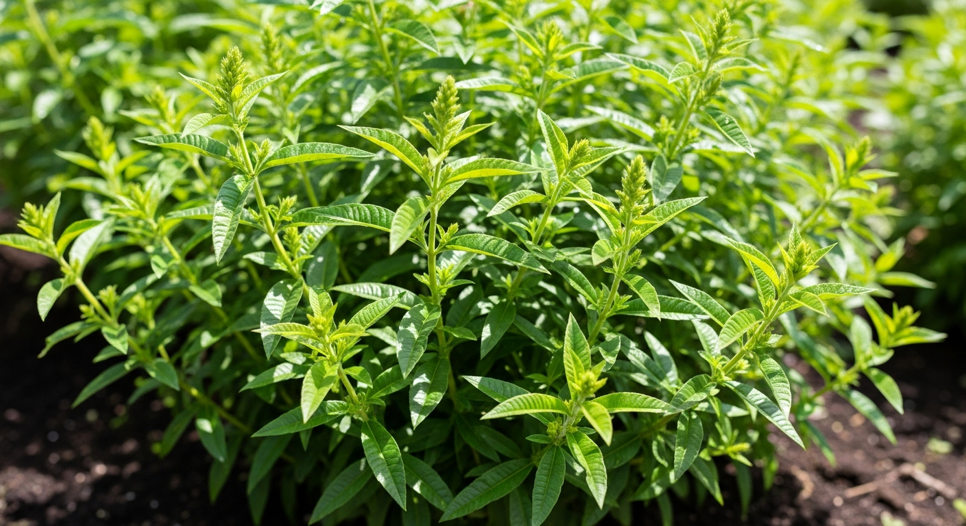
Lemon verbena oil is obtained by steam distillation of the leaves; the steam carries the volatile compounds, and once condensed the oil separates from the water. But the fragile structure of citral shows that the real work begins after distillation. Because the oil's compound profile changes with the harvest, the drying method and the storage conditions, what ensures batch-to-batch consistency is standardization: monitoring the compounds through analysis and keeping them within a defined range.
Considering that citral decreases over time, the issue with lemon verbena oil is not how fresh a single batch smells, but being able to preserve that fresh lemon note in every batch. The point Greenext emphasizes in its production of quality essential oils is precisely ensuring this continuity.
Frequently Asked Questions (FAQ)
Are lemon verbena oil and lemongrass oil the same thing?
No, but they are very commonly confused. The lemon herb in this article is Aloysia citriodora, that is lemon verbena, a shrub of the Verbenaceae family. Lemongrass, on the other hand, is a grass of the Cymbopogon genus from the grass family. The two come from different families; their common point is that both have a distinct lemon scent because both contain citral.
What compound gives lemon verbena oil its scent?
Most of the characteristic lemon scent comes from citral, that is a mixture of geranial and neral. This is largely the same as the molecule that gives lemon its own scent; for this reason lemon verbena smells very similar to lemon even though it is not related to it.
Why is lemon verbena oil preferred in cosmetics?
Both its fresh lemon note and its antioxidant compound profile make it interesting for perfumery and skin care formulations. Since essential oils are concentrated, they are generally used diluted or at a certain proportion within the formulation in cosmetic products.
References
- Packaging methods and storage duration affect essential oil content and composition of lemon verbena (Lippia citriodora Kunth.). Food Science & Nutrition, 2017. https://pmc.ncbi.nlm.nih.gov/articles/PMC5448364/
- Antioxidant and Antiproliferation Activities of Lemon Verbena (Aloysia citriodora): An In Vitro and In Vivo Study. Plants, 2022. https://pmc.ncbi.nlm.nih.gov/articles/PMC8951487/


