

The Mediterranean's Quiet Legacy: Olive Leaf Hydrosol
For thousands of years the leaves of the olive tree have stood at the centre of Mediterranean cuisine and tradition. What do they offer the skin when distilled into water? Could that gentle antioxidant touch sought for mature and tired-looking skin actually lie hidden in a hydrosol obtained from the leaves of Olea europaea?
From Leaf to Water: What Is Olive Leaf Hydrosol?
.png)
The hydrosol is the aromatic water phase that forms during the steam distillation of Olea europaea leaves. But how exactly does this water phase come about? The hot steam passing through the plant material carries both the volatile and the water-soluble components of the leaf together. During condensation the oily part (the essential oil) separates, and a lightly scented, component-laden water remains: this water is the hydrosol itself.
The most talked-about components of olive leaf are oleuropein and hydroxytyrosol, considered its building block. It should be underlined here: the hydrosol contains not the concentrated form of these components, but the gentle, aromatic fraction carried by water. In other words, instead of the high concentration the extract offers, there is a soft form that meets the skin in a friendly way. So where exactly is this gentle water useful in cosmetics?
Antioxidant Protective Care: Olive Leaf Hydrosol in Cosmetics
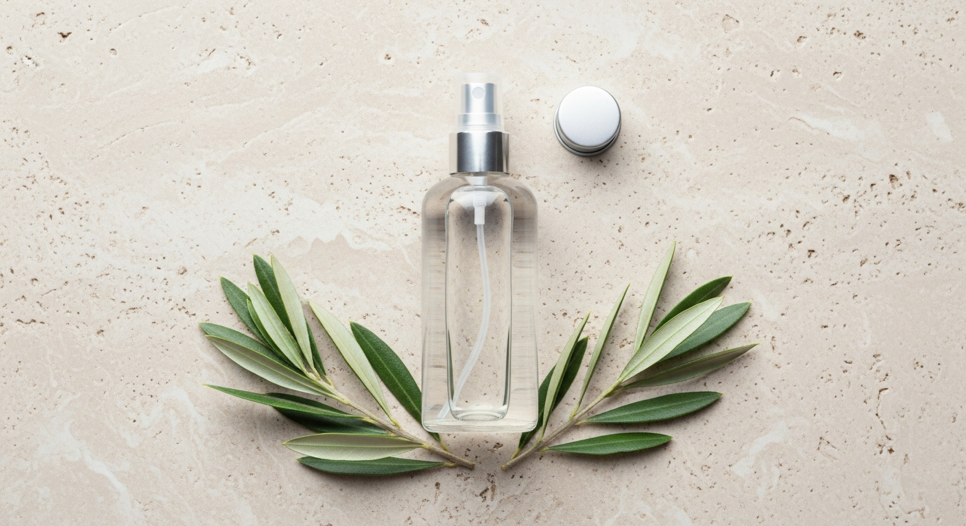
Olive leaf hydrosol is evaluated as a supporting component especially in formulations aimed at mature and worn skin care. Studies in which leaf extracts associated with antioxidant content were examined on UVA-stimulated skin fibroblasts, and their free-radical scavenging capacity was investigated, have increased the cosmetic interest in this plant. A separate study on oleuropein-enriched olive leaf and fruit extracts examined for cosmetic purposes investigated the effects of these extracts on enzymes that concern the skin matrix, such as elastase and hyaluronidase, and this too was found interesting in the context of mature skin care. The hydrosol, in turn, is the gentle, water-based and directly applicable face of all this interest. So what sense of freshness might tired-looking skin get from this light water phase added to a morning routine?
| Application area | Form of use | Key feature |
|---|---|---|
| Mature skin toners | As a facial mist or with cotton after cleansing | A refreshing touch associated with antioxidants |
| Face masks and serums | As the water phase of the formula | Light, water-soluble aromatic fraction |
| Daily refreshing mist | Misting onto the skin during the day | An instant sense of freshness for tired-looking skin |
Let us come to a thought-provoking point: if star components such as oleuropein are found in much higher concentrations in the extract and essential oil, what makes the hydrosol valuable? The answer is hidden in the form itself. Instead of the intensity that high concentration can bring, the hydrosol is a gentle carrier balanced with water, directly applicable to the skin and offering a sensory experience with its scent. When looking for a toner or mist, should we not ask whether strength always lies in the most concentrated form, or whether a balanced touch that harmonises with the skin is also valuable?
From Leaf to Product: Production and Standardisation
.png)
The composition of a hydrosol is not fixed. The geography where the plant grows, the harvest time and the distillation conditions directly affect the scent profile and component distribution of the resulting water. Even the same olive leaf can yield a different hydrosol when distilled under different conditions. So how is this variability managed for a reliable cosmetic raw material?
The answer lies in standardisation. Controlled distillation parameters and processes that ensure every batch carries the same scent and the same component profile turn the hydrosol into a consistent and predictable raw material. This is also the path Greenext follows in its olive leaf hydrosol: a traceable and standardised production that gives the same quality in every bottle. Is it possible to trust a component without consistency?
Frequently Asked Questions (FAQ)
Are olive leaf hydrosol and olive leaf extract or essential oil the same thing?
No, they are not the same. The extract and essential oil contain components such as oleuropein in concentrated form. The hydrosol, on the other hand, is the gentle, water-soluble aromatic fraction that passes into the water during distillation. In other words, the hydrosol is a lighter, water-balanced and directly applicable form, not a concentrated isolate.
Does olive leaf hydrosol cure skin problems?
The hydrosol is not a treatment or medicine but a cosmetic component. It is used as a supporting and sensory component in skin care formulations. For any skin condition, the right address is a health professional.
Why is it preferred for mature and tired skin?
Because olive leaf is known for components such as oleuropein and hydroxytyrosol, associated with antioxidant content, and these components have been examined in cosmetic research. By offering the gentle water phase of this plant, the hydrosol is preferred in refreshing, revitalising care routines aimed at mature and tired-looking skin.
References
- Valorization of the Photo-Protective Potential of the Phytochemically Standardized Olive (Olea europaea L.) Leaf Extract in UVA-Irradiated Human Skin Fibroblasts. Molecules, 2022. https://pmc.ncbi.nlm.nih.gov/articles/PMC9415354/
- Olive Fruit and Leaf Wastes as Bioactive Ingredients for Cosmetics, A Preliminary Study. Antioxidants (Basel), 2021. https://pmc.ncbi.nlm.nih.gov/articles/PMC7914505/
- Comprehensive Review of Olea europaea: A Holistic Exploration into Its Botanical Marvels, Phytochemical Riches, Therapeutic Potentials, and Safety Profile. Biomolecules, 2024. https://pmc.ncbi.nlm.nih.gov/articles/PMC11201932/


