

Rosemary Oil: An Essential Oil from the Kitchen to Hair Care
Over the past few years, rosemary has become one of the botanical names we most often run into on the ingredient lists of hair care products. How did that familiar fragrant plant we know from beside the meat in the kitchen end up in the formulas of shampoos, hair serums and scalp tonics? Much of the answer lies in rosemary oil, distilled from the plant's leaves, and in the volatile compounds it carries.
From Kitchen to Bottle: What Is Rosemary Oil?
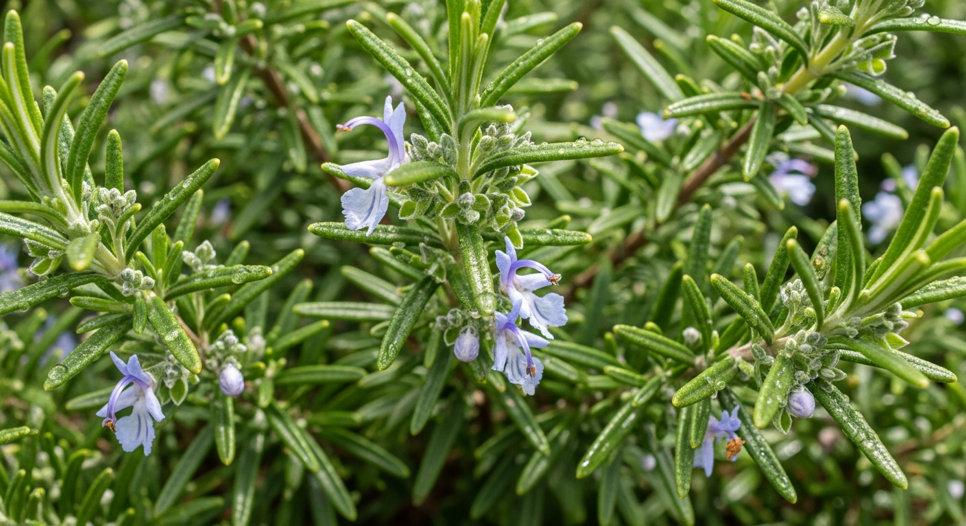
Rosemary oil is an essential oil obtained from the leaves of Rosmarinus officinalis, a plant native to the Mediterranean Basin. A member of the Lamiaceae family, rosemary grows wild in Turkey particularly around Adana, Mersin and Antalya, with a volatile oil content in its leaves of roughly 1 to 2 percent.
The leading compound that defines the oil's character is 1,8-cineole. Alongside it are terpenes such as α-pinene, camphor, verbenone, borneol and limonene; rosemary's fresh, slightly camphorous scent comes largely from these compounds. Here is the interesting part: the proportion of these compounds is not fixed. Depending on the climate and geography where the plant grows, the 1,8-cineole level can vary markedly; in samples of different origins this ratio has been reported to climb from 16 percent to above 30 percent, and as many as five distinct chemotypes have been defined.
Rosemary Oil in Hair and Scalp Care
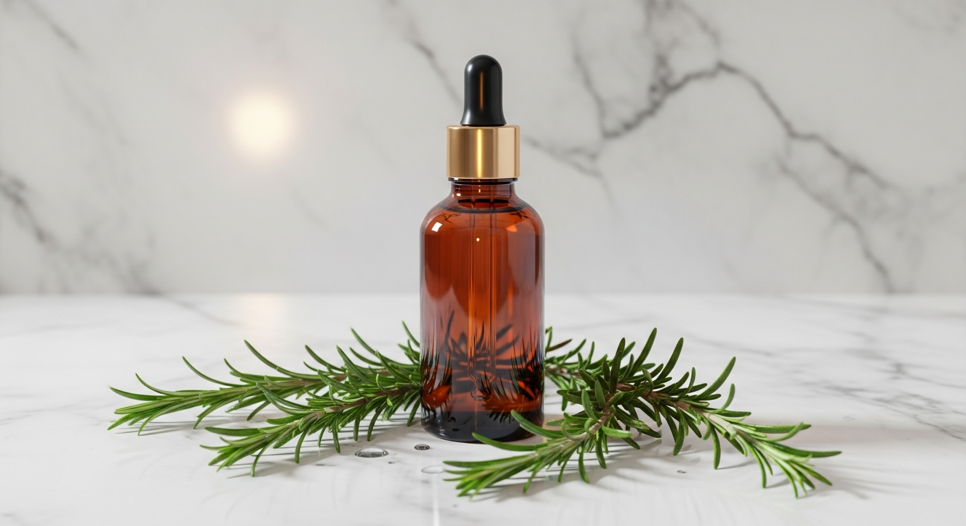
The most asked-about side of rosemary oil in cosmetics is its relationship with hair and scalp care. From shampoos to hair serums, from scalp tonics to massage oils, it appears as a botanical ingredient in many products. The interest here comes both from the oil's invigorating aroma and from its being the subject of scientific research in the context of hair care.
For example, a 2015 comparative study examined rosemary oil over six months in the context of hair care; at the end of the study an increase in hair count compared with baseline was observed, and scalp itching was reported to be less frequent than in the compared group. Studies like these make rosemary an interesting raw material for cosmetic formulations.
| Area of use | Form of use | Highlighted feature |
|---|---|---|
| Hair care | Shampoo, hair serum, scalp tonic | Invigorating aroma, 1,8-cineole |
| Skin care | Cleanser, tonic, massage oil | Aromatic and antioxidant profile |
| Perfumery and aromatherapy | Scent component | Characteristic fresh, camphorous note |
There is a thought-provoking point here. The word "natural" is often perceived as if it meant "always the same". Yet rosemary gathered from two separate fields can yield quite different oils; a compound dominant in one may be far lower in the other. So how does a cosmetic brand capture the same scent and the same compound profile in every bottle? The answer often lies not in nature itself, but in how that natural raw material is processed.
Consistency in Essential Oil: Production and Standardization

Rosemary oil is usually obtained by steam distillation of the leaves; the steam carries the volatile compounds from the leaf, and once condensed the oil separates from the water. But the real work begins after distillation. Given the natural variability in the raw material, what ensures batch-to-batch consistency is standardization: controlling the compound profile through analysis and keeping it within a defined range.
Considering the 1,8-cineole level that shifts by chemotype in rosemary oil, what matters for a cosmetic producer is not the quality of a single batch but every batch hitting the same profile. The repeatability that Greenext emphasizes in its production of quality essential oils is precisely this.
Frequently Asked Questions (FAQ)
Is rosemary oil applied directly to the hair or scalp?
Essential oils are quite concentrated; for this reason in cosmetic use they are generally included diluted within a carrier oil or a formulation. Rather than direct use of the pure essential oil, its proportion within the product formulation is what matters.
Why is rosemary oil preferred in hair care?
Both its characteristic invigorating aroma and its being the subject of scientific research in the context of hair and scalp make it interesting for cosmetic formulations. Even so, it is regarded as a cosmetic ingredient; on its own it is not a treatment method.
Why does rosemary oil's scent resemble camphor?
The reason is compounds such as camphor and 1,8-cineole within the oil. These terpenes give rosemary its fresh, slightly sharp and camphorous scent; the intensity of the scent also varies with the oil's compound profile.
References
- Chemotypic Characterization and Biological Activity of Rosmarinus officinalis. Foods, 2017. https://pmc.ncbi.nlm.nih.gov/articles/PMC5368539/
- Rosemary oil vs minoxidil 2% for the treatment of androgenetic alopecia: a randomized comparative trial. Skinmed, 2015. https://pubmed.ncbi.nlm.nih.gov/25842469/


